
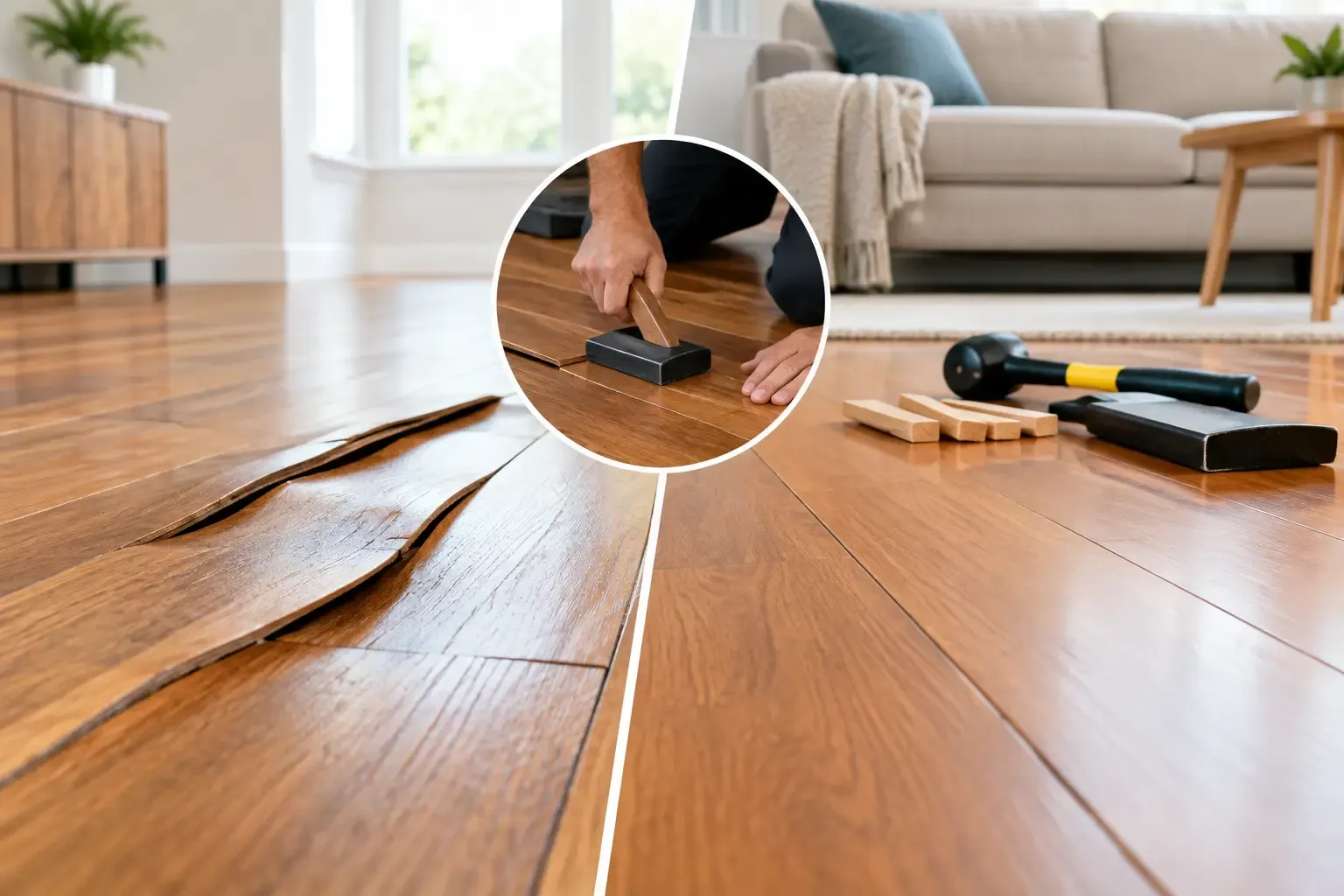
A hardwood floor that once felt flat but now has raised board edges and low centers is signaling a moisture problem, not simply a sanding problem. Effective hardwood floor cupping repair begins by stopping the moisture movement that caused the boards to distort. Sanding too soon can turn a repairable floor into one that needs replacement.
Cupping is common after a plumbing leak, a wet basement, seasonal humidity swings, or water tracked in through an exterior door. It can also develop slowly when moisture rises from a crawl space or concrete slab below. The right solution depends on the wood species, floor construction, moisture readings, how long the condition has existed, and whether the flooring can return to its normal shape.
What Hardwood Floor Cupping Looks Like
A cupped board has higher edges than its center. When several boards cup together, the floor may feel wavy underfoot or show shadow lines along the seams. In severe cases, the edges can catch socks, collect dirt, or begin to wear through the finish.
Cupping happens because one side of the board contains more moisture than the other. Most often, the underside absorbs moisture from the subfloor, basement, crawl space, or a leak, while the finished surface remains comparatively dry. Wood fibers expand as they absorb water. Since the bottom of the board expands more, the board bends upward at both edges.
This is different from crowning, where the center of a board sits higher than the edges. Crowning may result when a floor was sanded while cupped and later dried, or when excess moisture reached the top surface. Telling the difference matters because the repair approach is not the same.
Find the Moisture Source Before Repairing the Floor
The visible distortion is only part of the diagnosis. A professional evaluation should identify where moisture entered, whether it is still active, and whether the subfloor is holding excess moisture. Without this step, a newly sanded or refinished floor may cup again after the first humid season.
Start with the practical causes: a leaking refrigerator line, dishwasher connection, toilet seal, radiator, roof leak, wet exterior wall, or pet-related water damage. In Maryland and Washington, DC homes, seasonal humidity and damp lower levels are also frequent contributors. Older homes with crawl spaces and newer homes with wood flooring installed over concrete can both have moisture-control challenges.
A flooring professional uses moisture meters to compare the hardwood, subfloor, and surrounding conditions. Readings help determine whether the wood is still wet, stabilizing, or dry enough for corrective work. The floor should also be checked for loose boards, black staining, mold concerns, finish failure, and damage beneath appliances or along exterior walls.
If there is an active leak, call the appropriate plumbing, roofing, or water-mitigation professional first. Flooring repair comes after the cause is controlled. Emergency drying may include dehumidification, air movement, and carefully managed heat, but aggressive drying can create new stress in the wood. The goal is steady stabilization, not a rushed cosmetic fix.
Can Cupped Hardwood Floors Flatten on Their Own?
Sometimes, yes. Solid hardwood has a degree of resilience. If moisture exposure was brief and the boards have not permanently deformed, the floor may flatten substantially as indoor humidity and moisture content return to normal. This process can take weeks or months, especially when moisture entered from below.
Patience is often the least expensive part of hardwood floor cupping repair. Homeowners understandably want to restore the floor immediately, but sanding a floor that is still swollen removes wood from raised edges. Once the floor dries and flattens, those over-sanded edges can leave each board crowned or uneven.
A stable indoor environment supports recovery. Keep indoor relative humidity generally in the range recommended for wood flooring, commonly around 35% to 55%, while following the guidance of the drying professional. Use dehumidification where needed, keep drainage directed away from the foundation, and avoid repeatedly soaking the floor with wet mops.
Not every floor will return fully to level. Long-term moisture exposure can set the distortion into the boards, weaken fasteners, stain the wood, or damage the subfloor. Engineered hardwood also requires special care because its wear layer is thinner than solid wood. It may be refinishable, but only after confirming the product’s construction and remaining thickness.
Hardwood Floor Cupping Repair Options
Once moisture readings confirm the floor has stabilized, the repair can be matched to the actual condition. The best option is not always the most extensive one.
Drying and monitoring
For mild cupping with no lasting damage, controlled drying and periodic moisture checks may be enough. Minor texture changes can become far less noticeable once the boards settle. This approach preserves the most original material, which is especially valuable in historic homes with older strip flooring or character-grade wood.
Sanding and refinishing
If boards have stabilized but remain uneven, sanding can level the surface and remove water marks, worn finish, and shallow staining. This work requires judgment. The floor must be flat enough and thick enough to sand safely, and the sanding sequence must remove only what is necessary.
Refinishing also provides an opportunity to update the color, choose a durable finish system, or blend repaired areas into the surrounding floor. Dustless sanding helps contain airborne dust during preparation, although no job site is entirely dust-free. Careful masking, cleanup, and finish curing time still matter.
Board replacement and localized repairs
Boards that are split, deeply stained, delaminated, loose, mold-affected, or permanently misshapen may need replacement. Matching species, board width, grade, and grain direction makes a major difference in the final appearance. In older flooring, replacement boards may need custom staining and selective blending rather than a one-color approach.
Localized repair works well when damage is confined to a small section, such as below a leaking dishwasher or near an exterior door. If moisture traveled widely beneath the floor, replacing only the visibly damaged boards may not address the full problem. Subfloor repairs or moisture-barrier corrections may be necessary first.
Subfloor and installation corrections
When cupping repeatedly returns, the floor system deserves a closer look. Inadequate vapor protection, excessive subfloor moisture, poor crawl-space conditions, insufficient expansion space, or flooring installed before it acclimated can all contribute. Correcting these conditions is more involved than refinishing, but it protects the investment for the long term.
When Sanding Is the Wrong First Move
Sanding is the most common shortcut and one of the costliest mistakes when timing is wrong. Do not sand a cupped floor immediately after a flood, leak, or humid period simply because the edges look rough. The surface may appear dry while the underside and subfloor still hold moisture.
Avoid applying a fresh finish over a floor with ongoing moisture problems as well. Finish cannot stop moisture entering from below, and trapping a damp condition can lead to adhesion failure, cloudy areas, or continued movement at the seams.
Be cautious with do-it-yourself belt sanding. Hardwood floors can be damaged quickly by uneven pressure, aggressive grit choices, or sanding across the grain. Engineered flooring is particularly unforgiving. A professional assessment can determine whether sanding is appropriate before material is removed.
How to Prevent Cupping After the Repair
Prevention is mostly about consistency. Wipe spills promptly, use mats at exterior doors, and avoid rubber-backed mats that trap moisture against the finish. Maintain stable indoor humidity through heating and cooling seasons, particularly in rooms with large windows, lower-level exposures, or limited ventilation.
Keep gutters, downspouts, and grading working away from the foundation. Address plumbing drips before they become flooring problems. For basements, crawl spaces, and concrete-slab installations, moisture management below the floor is as important as the finish above it.
If your floor is cupping, document the area with photos before moving furniture or starting cleanup. That record can help a flooring professional trace the pattern of the damage and determine whether the issue came from above, below, or within the building envelope.
A careful on-site evaluation saves time, avoids premature sanding, and gives you a repair plan based on moisture, construction, and the condition of the wood. For homeowners in Montgomery County, Baltimore County, and nearby Maryland communities, Refinish My Floors can assess the affected floor, explain the practical options, and help you move from damage control to a finish that looks right and lasts.